

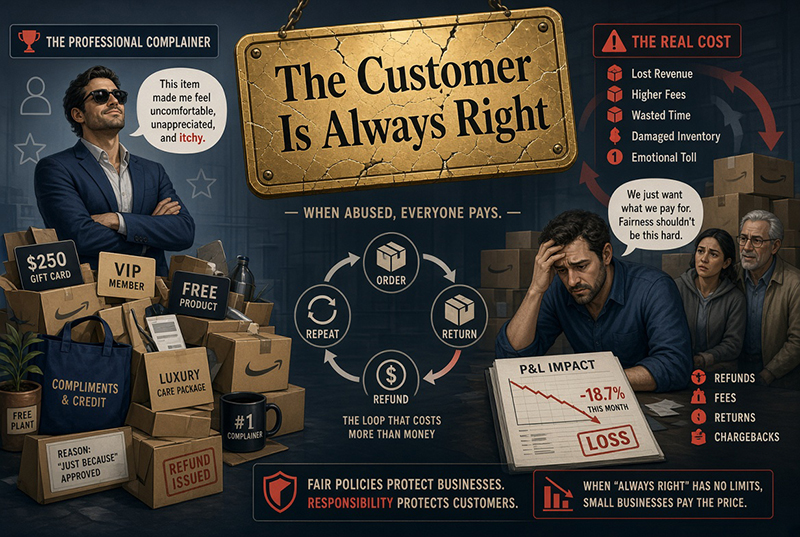
Summary: When the customer is always right becomes a costly myth, professional complainers and return scammers exploit generous service recovery policies for free products and refunds. Drawing from real advertising-agency experience and today’s Amazon return abuse, this article examines the line between legitimate complaints and deliberate fraud, the hidden costs to honest customers and seller margins, and practical ways marketers can design fair recovery policies that protect loyal buyers without enabling serial abusers. Learn why companies must sometimes say no—and how smart policy design preserves both trust and profitability.
Professional complainer as scam artist
In my early career I worked for the owner of an advertising agency who had spent years designing sophisticated customer retention and loyalty programs for major brands. She understood exactly how those systems worked, including the service recovery policies that rewarded complaints with free products, credits, or upgrades.
She turned that insider knowledge into a quiet side hustle. She would deliberately order products or use services, then craft detailed complaint letters or make carefully timed phone calls describing exaggerated problems. Because she knew the internal escalation processes, she almost always walked away with generous compensation. She proudly displayed her “haul” in the office and even had employees redeem the coupons for her.
That experience stayed with me. What once felt like an isolated, almost clever abuse of the system has become far more common and far more organized.
Today the modern versions of this behavior appear everywhere, especially with Amazon. Many people order items, use or consume them, and then return or complain to secure a full refund. Others move into more deliberate fraud: swapping a broken, used, or counterfeit item with the new one before returning it, or claiming an item never arrived when tracking clearly shows delivery. Some even record the process and post it on social media, treating the free product as a trophy.
Amazon’s famously generous return policy helped build enormous customer trust. That same policy is now being systematically exploited by serial returners and organized fraud rings.
The line between advocacy and abuse
There is a difference between a customer who has a legitimate problem and one who treats service recovery as a personal revenue stream. The first is someone companies should work hard to satisfy. The second is someone who quietly transfers cost onto every other customer and onto the sellers who absorb the losses.
Companies have long been told that the customer is always right. That slogan was useful when most interactions were genuine. It becomes destructive when a small but persistent group learns how to game the system and does so repeatedly. At some point a business must decide whether it has the right to identify chronically unprofitable or dishonest customers and stop serving them. Refusing to do so does not protect the brand; it subsidizes the people who abuse it
The hidden costs of over-satisfaction
When a company repeatedly rewards the same abusive behavior, several things happen. Honest customers eventually subsidize the losses through higher prices or reduced service. Seller margins shrink, especially for smaller third-party sellers who cannot absorb repeated refunds and return shipping. Over time the brand’s profitability erodes, and the very generosity that once built loyalty begins to look like weakness.
The professional complainer and the scam artist do not merely take free products. They train the system to treat good-faith customers with increasing suspicion and friction. That is the real long-term damage.
Designing programs that reward the right customers
Generous service recovery policies only work when they are paired with clear boundaries and intelligent differentiation. The objective is not to become stingy or suspicious of every customer. It is to make genuine problems easy to resolve while making repeated abuse progressively more difficult and less rewarding.
Start with customer history and lifetime value.
A first-time complaint from a long-term, high-value customer should still receive a high-touch recovery. The same complaint from someone with a pattern of returns, chargebacks, or escalations can trigger a different process—stricter verification, limited credits, or a simple refusal. Modern systems already track this data; the missing piece is giving frontline teams the authority and guidelines to use it.
Build pattern detection into the recovery process.
Serial returners, item-swappers, and professional complainers leave digital footprints. Automated flags for unusually high return rates, repeated “item never arrived” claims against clear tracking data, or multiple identical complaint scripts can route those cases to a specialized review team rather than the standard refund path. The honest customer never notices. The scammer does.
Create graduated consequences instead of an all-or-nothing approach.
Early warnings, temporary restrictions on free returns, or a requirement for more documentation give customers a chance to correct course. Persistent abusers eventually lose access to the most generous benefits. Some companies already quietly “fire” the worst offenders by declining future business. That option should be an explicit, documented part of the policy rather than an informal last resort.
Design loyalty and recovery benefits with intentional friction for abuse.
Instant, no-questions-asked refunds are powerful for trust-building, but they can be paired with soft limits, purchase history checks, or post-refund audits on high-risk accounts. The genuine customer still feels cared for. The professional complainer finds the game less profitable.
Communicate the boundaries.
Customers who play by the rules should understand that the company protects them by refusing to subsidize those who do not. Clear, public language about fair use of returns and recovery policies signals that the brand values honesty as much as satisfaction.
When recovery programs reward loyalty and honesty while systematically raising the cost of exploitation, the old slogan can finally be retired. The customer is not always right. The right customer is.
###badphd